
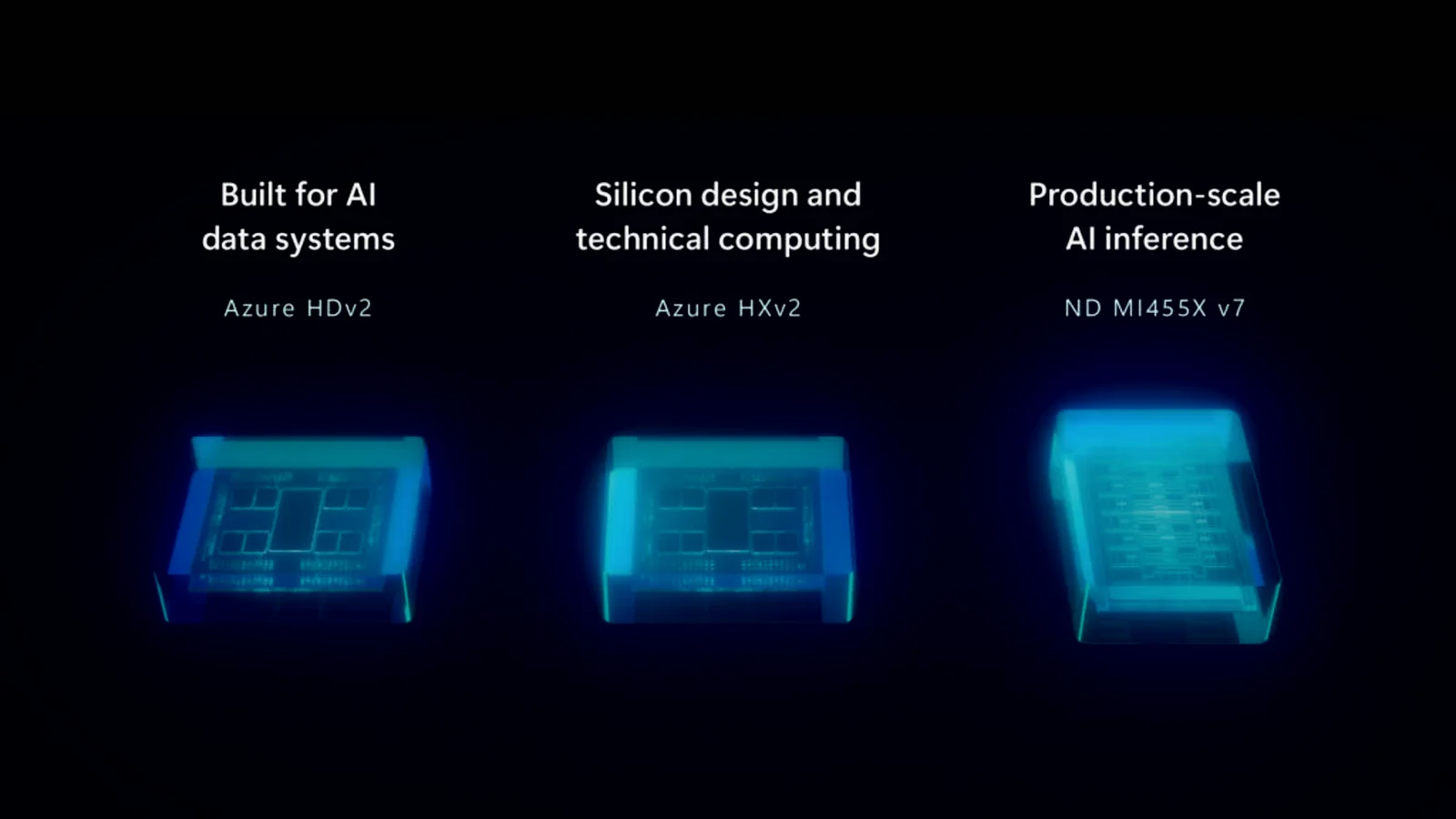
Microsoft is expanding Azure with three AMD-powered systems designed for different parts of the AI computing stack: large-scale data processing, silicon design, and production inference.
The announcement reflects a wider change in cloud infrastructure. Modern AI workloads are no longer served efficiently by one general machine type, so providers are assembling specialized systems around the bottleneck each workload creates.
Three systems for three workloads
Azure HDv2 virtual machines are designed for data preparation, search, reinforcement learning, and agent coordination. Microsoft says the systems combine nearly 500 physical AMD EPYC CPU cores with four terabytes of memory, local NVMe storage, and high-speed networking.
HXv2 targets electronic design automation and other technical computing. ND MI455X v7 uses AMD's Helios rack-scale platform for reasoning, search, and high-volume inference.
AI infrastructure is becoming heterogeneous
The expansion gives Azure customers more alternatives to a single accelerator path. CPUs, GPUs, memory, storage, networking, and software libraries increasingly need to be selected as one system rather than purchased as interchangeable parts.
Microsoft is positioning customer choice as a core design principle, combining AMD hardware with its own silicon and other accelerator families across Azure.
Software still decides the usable value
Hardware capacity matters only when teams can schedule it, move data efficiently, observe failures, and keep utilization high. The surrounding cloud software will determine whether specialized infrastructure reduces cost or adds operational complexity.
For product teams, the announcement is another sign that model selection and infrastructure selection are becoming one decision. Latency, throughput, reliability, and price must be measured against the real workload rather than a headline benchmark.